Showing posts with label people. Show all posts

Friday, November 5, 2010

Philosophy

A statue of Confucius (551–479 BC) in the Chinese Garden of the Rizal Park.

statue of Confucius at the Rizal Park
"When we see men of worth, we should think of equaling them;
when we see men of a contrary character,
we should turn inwards and examine ourselves."

Monday, October 25, 2010

About a Filipino and two colonial governments

The remains of Philippine national hero Jose Rizal are now interred at the site where he was executed by the Spanish colonial government on December 30, 1896. The area was called Bagumbayan (New Town) then and was located just outside the old walled city of Intramuros. It is now called Rizal Park in honor of the man whose great sin was to ask—he was a writer and didn't even take up arms—that the rights of Filipinos be recognized in their own country. The bronze and granite Rizal Monument was planned and constructed during the American colonial era and designed by the Swiss sculptor Richard Kissling. It is guarded continuously by ceremonial guards called the Kabalyeros de Rizal (Knights of Rizal).

Rizal Monument

Tuesday, August 10, 2010

Art as activism

Kiri Dalena, here being photographed by Cocoy Sarmenta, is a visual artist and film director.

artist Kiri Dalena being photographed by Cocoy Sarmenta


Her installation Watch History Repeat Itself is on display in the Ateneo Art Gallery until August 16.

Watch History Repeat Itself art installation by Kiri Dalena at the Ateneo Art Gallery


This is not art which is meant to decorate a room to make it pretty. It is art that wants to say something. And in Dalena's case, that something is Philippine political commentary, executed ironically in blinking, commercial neon. Below is an excerpt from the essay "History in Translation" written by film maker and writer Adjani Arumpac, and a video tour of the complete exhibit taken by Manila Art Blogger.
    A blinking white neon sign screaming Liar! Liar! Liar! randomly illuminates a black room, recalling reactions to statements issued by the Gloria Macapagal-Arroyo government—from the infamous Hello Garci controversy to over 1,000 alleged extra-judicial killings throughout its nine-year reign. A red neon sign that floods red light in a white vacant area reads Dear activist, write a slogan for me tenderly invites one to contemplate past and ongoing brutalities denounced by various sectors in countless angry statements against the government. 
    That neon signs, ubiquitous visual polluters and commercial vendors of the modern world, give light to such provoking statements reveals what the artist sees as a paradox—commercial and political interests of the ruling elite are protected by the state through various mechanisms such as brute armed strength. 
    Dalena's aesthetics banks on a pervading sense of terror in real-time, continuing. But this sense of immediacy and urgency, an energy usually taken out in the streets, is forcefully brought to a standstill by the artist. She chooses to show tragedy as history, as clearly advertised by a blinking neon light that spells History. In the same vein, transferred in the Yellow Book of Slogans are rally calls culled from photo-documentation of rallies waged against the nine-year Arroyo regime. Likewise, inscribed in a single funerary slab are the haunting words: Watch History Repeat Itself, an abridged text displayed during Cory Aquino's funeral march. 
    Dalena wrests these texts out of the streets and entombs them in forms and mediums that significantly depart from traditional protest art, wherein prime is given to fast production, accessibility and portability, whose end is to provide visual support for street mobilizations. She doubly gives weight to her cause, literally, by trading permanence for transience through writing ephemeral protest call in black and white and in stone.

Friday, July 30, 2010

Just call him Fr. Jojo

July 31 is the Feast Day of St. Ignatius of Loyola, founder of the Society of Jesus. Last year, I introduced the order's Superior General, the Very Reverend Adolfo Nicolás, SJ. This year, let me introduce the head of the Society's Philippine Province, Rev. Jose Cecilio J. Magadia, SJ. His official title is Provincial Superior though his continued humility belies the exalted position. Every now and then, I see him walking from the Province House in Loyola Heights to the Ateneo de Manila University—alone, in t-shirt and jeans.

Fr. Jose Cecilio J. Magadia, SJ, Provincial Superior of the Society of Jesus in the Philippines

Sunday, June 27, 2010

More Filipino than…

Roman Ongpin (1847–1912) was a Chinese-Filipino businessman, nationalist, civic leader, patron of the arts and philanthropist. He was born in Binondo, Manila's Chinatown, of immigrant parents. He secretly supported the Philippine Revolution against the Spanish colonial government and, when the Philippine-American War broke out, Ongpin again secretly supported the revolutionaries against the U.S. But the Americans found out and he was imprisoned from 1900–1901. Binondo's most famous street—the one with the funny street sign—is named after him.

statue of Roman Ongpin in Binondo, Manila


CDP bloggers! There are only three days left to vote for the August theme and to prepare your photo for the July 1 theme day: Reflections. Why do I have the feeling that James was the inspiration for this one?

Tuesday, April 27, 2010

Porcelain and artillery

The San Diego was a 16th century galleon, a three-masted trading ship built in 1590 in the province of Cebu by Spanish, Chinese and Filipino shipbuilders. It used different kinds of Asian woods and was about 35–40 meters (115–130 feet) long, 12 meters (39 feet) wide and 8 meters (26 feet) high. It had at least four decks and could hold about 700 tons of cargo.

model of the 16th century galleon San Diego


In November of 1600, the San Diego was refitted by the Spanish colonial government to help fight Dutch corsairs who were preying on ships entering Manila harbor. The battle took place in December and resulted in a draw, with one Dutch ship, the Mauritius, catching fire, and the San Diego, which was still laden with cargo and overloaded with the added artillery and ammunition, sinking.

model of the 16th century galleon San Diego


Antonio de Morga, who led the Spanish fleet and survived to write about the attack in his book Sucesos de las islas Filipinas in 1609, only mentioned that the San Diego sank somewhere south of Manila Bay.

Antonio de Morga


It was not until 1991 that the San Diego wreck was discovered off the town of Nasugbu in the province of Batangas. In 1992, the galleon was excavated with the help of hundreds of people of different nationalities and the support of the Philippine, French, German, Spanish and American governments.

diorama of the San Diego underwater excavation


To date, the San Diego shipwreck is the Philippines' most important underwater archeological discovery. Of the more than 30,000 artifacts found in the shipwreck, 5,000 are now in the Museum of the Filipino People. The artifacts include Chinese porcelain, Japanese swords, European cannons, helmets and astrolabes, and Mexican coins. Understandably, the San Diego collection is one of the museum's most extensive and important exhibits.

some of the artifacts from the San Diego displayed in the National Museum of the Filipino People

Saturday, April 24, 2010

Le Français dans un barong Tagalog

Meet the gentleman behind the wonderful service of Bellarocca Island Resort and Spa, its general manager Jan Michel Gautier. This Frenchman, who is always in a barong Tagalog, has lived in the Philippines with his family for twenty years, though his expertise in the hotel and restaurant industry takes him all over the world. Michel must really love sunsets. He works in an island with beautiful sunsets over Tayabas Bay; in Manila, his home is on Roxas Boulevard, right beside Manila Bay with the best sunset views in the entire metro.

Jan Michel Gautier

Monday, March 22, 2010

Another first

The Far East Broadcasting Company (FEBC) is an international Christian radio network that broadcasts programs in 130 languages. Founded in 1945 by Americans John Broger and Robert Bowman, it set up its largest Asian base in the Philippines and it went on air in the country in 1948. The offices, homes and dormitories of the missionaries of FEBC Philippines are in Valenzuela, one of Metro Manila's northern-most cities, bordering on the province of Bulacan where their transmitters are located. (This is just a back-up transmitter.)

Far East Broadcasting Company (FEBC) Philippines


I have to say that blogging about Metro Manila has given me so many new experiences this past year, not the least of which was getting invited by FEBC (702 DZAS in Manila) as a guest in one of their radio programs last week. Meet Lem and Lj, the hosts of the Monday to Friday "Pinoy Espesyal" (Filipino Special) program. Lem and Lj are so natural that the interview felt just like having a discussion with friends. I think I still sounded nervous though, because that booth is cold and I couldn't stop shivering!

Lem and Lj, hosts of the radio program Pinoy Espesyal in 702 DZAS


When they were winding up the show, I was able to take a photo of CJ, their radio technician, in his booth. It's a good thing I keep my camera's shutter sound off—I didn't notice the 'on air' light until I downloaded the photos.

CJ, the technician of the radio program Pinoy Espesyal in 702 DZAS


I'd like to thank Lj for this singular experience, and I hope I didn't do too badly. It was great meeting so many nice people in FEBC and it was wonderful walking around their large and green compound. It didn't feel like it's in the middle of busy and crowded Valenzuela City and I'll post photos of it soon.

Sunday, March 14, 2010

One night of surprises

Thanks to a classmate from my university days a long time ago, Chinoy Eater (who irritatingly still looks like she's in her early twenties—no fair!), I was invited by Patricia Tan of Events 100 to "One Night Only" last March 4. The minimalist invitation only said that it was cocktails at the Hampton Room of Astoria Plaza in Ortigas Center, Pasig City but Patricia mentioned in her email that it was also a celebration of Astoria's 9th anniversary. Intrigued, since I've never been to such an event, I asked my husband if we could go and he said yes, so we did. When we got to the hotel, the first thing that caught my eye in the Hampton Room was the wonderful light fixtures, an arboreal fantasy.

lighting fixture of the Hampton Room of Astoria Plaza


The room was set up with a small stage and a large video screen, so I immediately figured, correctly as it turns out, that it was a media event. Before the presentations, we were invited to have some cocktails. I just loved how the hotel staff laid out the forks to look like a palm frond, complete with green lights to heighten the effect.

forks laid out to look like a palm frond


My husband loved their crème brûlée. Isn't the presentation just so pretty? And the mirrored surface of the cocktail tables made everything look dazzling.

Astoria Plaza's creme brulee


The purpose of the media event was three-fold. First, Astoria launched its new logo, cleverly embedded in an ice sculpture. Second, they introduced their newest celebrity endorser, Boy Abunda, who is one of the most famous and sought-after talk show hosts in the Philippines. And third, they announced the re-opening of Astoria Boracay. Located in the world-famous Boracay Island, with its fine white sand beaches, in the province of Aklan, the resort used to be known as Boracay Gold Crowne. The Astoria group acquired the resort in 2008, extensively renovated it, and the new rooms and facilities will be available this April, just in time for summer. In the photo are Astoria Plaza Hotel Manager Ping Regalado, Boy Abunda and Vice President for Operations Vivian Ng.

Ping Regalado, Boy Abunda and Vivian Ng with Astoria's new logo


For attending the event, the guests—tri-media practitioners and bloggers, all—were given laptop bags and made official members of Astoria's First Club, which means that we will be invited to anything new that Astoria has to offer (more photos for me—whee!). And the best surprise of all, we were also invited to stay at the new Astoria Boracay for three days and two nights—double whee! Would you believe we've never been to Boracay? I know, pathetic. So we are definitely looking forward to the trip later in the year. I'm already so excited! I wonder if the resort will have chairs as unusual and lovely as these ones in Astoria Plaza's lobby…

unusual chairs at the lobby of Astoria Plaza

Tuesday, February 23, 2010

The mice will play

Just before guests were expected to arrive at the gala night of the sarswela "Walang Sugat" at the Ateneo de Manila University, the ushers in their formal Filipiniana clothes took turns posing in front of the photo wall made of wood and capiz shell. These panels echo the windows and screens found in old Spanish colonial houses, rarely seen nowadays except in a few preserved historical homes. I loved how Nico and Tonette were so un-selfconciously enjoying themselves hamming it up for the photographer that I decided to snap a photo of them myself.

Nico and Tonette hamming it up in Filipiniana attire
Last Saturday's gala was a work night for me too so I didn't watch the play nor get other photos. I hope to watch this weekend and since they're allowing photos, as long as you don't use a flash, expect a few from me in the near future. In the meantime, I have a little information about the sarswela form here, and the university website has some photos of "Walang Sugat" here.


May I please ask you all to help me welcome Mia of Life in Manila.... and elsewhere to CDP? Mia lives and works in the southern part of the metro, and works for a foundation that supports many social development and charity organizations, and you'll be seeing many photos from her that I will probably never have on my blog. Mia is also a personal friend of ours and this is her nth blog—she keeps starting one then stopping, starting and stopping, you get the idea. If she gets a warm welcome from the community, then just maybe, she'll be inspired to continue this latest one. Thanks, everyone!

Wednesday, February 17, 2010

First Filipino

Fr. Horacio V. de la Costa, SJ (1916–1977), Atenean, historian, writer, teacher, priest, patriot. The first Filipino dean of the college of arts and sciences of the Ateneo de Manila University. And the first Filipino superior of the Philippine province of the Society of Jesus.

Fr. Horacio V. de la Costa, SJ

This statue, a gift of the Ateneo High School Class of 1952, stands in front of the building which bears his name, the Horacio de la Costa Hall, which is currently the home of the Ateneo de Manila's Loyola School of Humanities.

Fr. Horacio V. de la Costa, SJ


Reminding all CDP bloggers: The theme for our March Theme Day is Passageway. The April Theme Day poll is up too and we get two choices again, thanks to Demosthenes. Please vote and spread the word!

Monday, January 25, 2010

A statement

Yesterday was the birthday of former president Corazon Aquino, who died on August 1, 2009. She would have been 77. According to our newspapers, more than 400 Masses were offered for her, in the Philippines and in cities all over the world with large Filipino communities. I think that the overwhelming tribute for her these past few months since her death is not really a statement about her effectiveness as a president, which some people would question (but to be fair, her presidency was extremely tough, coming as it did after more than two decades of Ferdinand Marcos' dictatorial rule). Rather, it is a reflection of how we Filipinos are (finally) yearning for ethical leaders, especially after the countless corruption accusations that have rocked this current government.

yellow fan with ribbon
Yellow has always been Cory's color. Instead of wearing yellow shirts, most people nowadays sport a little yellow ribbon pin to show their support for the ideals that Cory embodied. One of Cory's former doctors gave away these yellow fans with ribbon-shaped handles made of handmade paper at the Mass and tribute that my husband and I attended yesterday.

Friday, January 22, 2010

We await you still

This statue of the young Jose Rizal, Philippine national hero, is in the Ateneo de Manila High School and a gift of Class 1997. The inscription at the base is a quotation from Rizal's second novel El Filibusterismo, published in 1891, and spoken by the priest Father Florentino in the concluding chapter:
    Where are the youth who will consecrate their golden hours, their dreams, and their enthusiasm to the welfare of their native land? Where are the youth who will generously pour out their blood to wash away so much shame, so much crime, so much abomination? Pure and spotless must the victim be that the sacrifice may be acceptable! Where are you, youth, who will embody in yourselves the vigor of life that has left our veins, the purity of ideas that has been contaminated in our brains, the fire of enthusiasm that has been quenched in our hearts? We await you, O Youth! Come, for we await you!

statue of the young Jose Rizal at the Ateneo de Manila High School

Wednesday, January 20, 2010

Artistic temperament

We've all heard about how artists of all kinds can be very emotional and temperamental. It probably isn't true of many artists, but by all accounts, it was true of Juan Luna (October 23, 1857 – December 7, 1899), the painter of yesterday's Spoliarium. Born in the town of Badoc in the province of Ilocos Norte, Luna was discharged from one art school in Manila because he refused to follow what his teacher wanted, and he left another in Madrid because he didn't like their teaching style. He married Maria de la Paz Pardo de Tavera in 1886 and they settled in Paris. Only six years later, Luna, in a fit of jealousy, killed his wife and mother-in-law, and wounded his brother-in-law. This small sketch of Juan Luna hangs in the Luna and Hidalgo Gallery of the National Art Gallery, where the Spoliarium is also located. I now forget if this was a self-portrait or drawn by an artist friend. It was done in Rome in 1879, before the Spoliarium and before the marriage, and he does not yet have the handlebar mustache of his later portraits and photos.

Juan Luna

Monday, December 14, 2009

Unbelievable

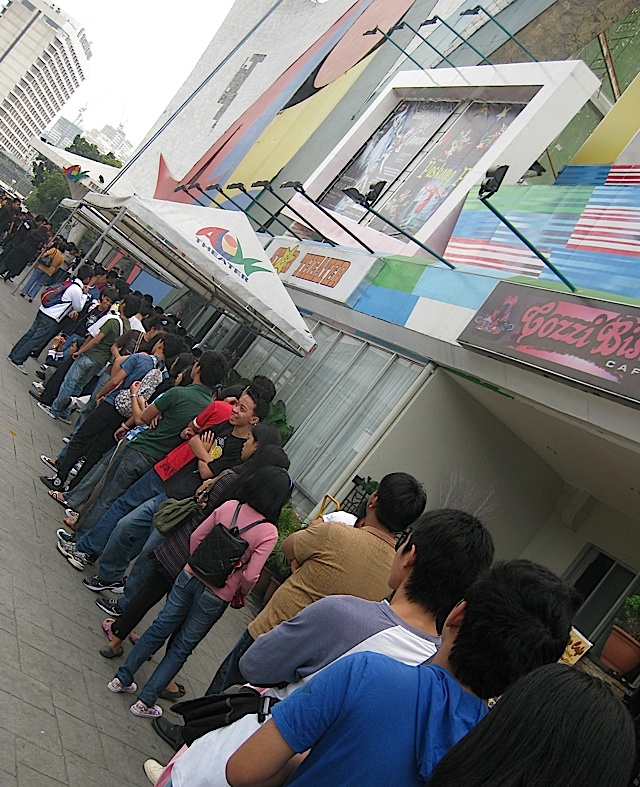
Would you believe hundreds of 16 to 18 year old first year college students orderly and patiently lined up to watch a ballet? By the time Ballet Manila's performance started in the Aliw Theater, there were about a thousand of them. And even more astounding, they actually enjoyed it! Tomorrow, I'll show you why.

16 to 18 year old students lined up to watch Ballet Manila at the Aliw Theater

Sunday, December 13, 2009

Crowning glory

I wish I could properly introduce you to pretty Em, one of the servers at Sofitel Manila's 7Pecados by the Bay, but when I asked if I could take her photo, she shyly shook her head no. When I said that I wanted to take a photo of her gorgeous, long, curly hair, she willingly posed for me.

Em's beautiful, long, curly hair

Wednesday, December 2, 2009

Two mathematicians

As part of the countdown to the Ateneo de Manila University's 150th anniversary, Philippine pianist Raul M. Sunico performed at the Church of the Gesù on Tuesday evening. Trained at the University of the Philippines, Juilliard School and New York University, Dr. Sunico's wonderfully eclectic program included pieces from Frederic Chopin, Isaac Albeniz, Claude Debussy, Franz Liszt and George Gershwin. The list of Dr. Sunico's many accomplishments as a concert pianist, orchestral soloist and musical arranger—both internationally and locally—is too long to include here, but beyond his brilliant piano playing, there are two things that endear him most to me: he arranged Filipino folk songs and kundiman (traditional love songs) for classical piano and recorded them in fifteen volumes—a legacy that will forever enrich Philippine culture; and his many projects on music education, especially for grade school children.

the Ateneo Church of the Gesù during the concert of Raul M. Sunico

I do not have a photo of Raul Sunico at the piano, unfortunately. The conditions during the concert—dim ambient light, strong spotlights, a pianist that performs with his entire body—were just too tough for my little camera. But I did get one during the photo-op before the concert. So, without further ado, let me introduce to you the president of the Ateneo de Manila University, Fr. Bienvenido F. Nebres, SJ and Dr. Raul M. Sunico, Artistic Director of the Cultural Center of the Philippines, Dean of the University of Santo Tomas Conservatory of Music and pianist extraordinaire.

Fr. Bienvenido F. Nebres, SJ and Dr. Raul M. Sunico

Wednesday, October 7, 2009

Training grounds

The Moro Lorenzo Sports Center (MLSC) of the Ateneo de Manila University was constructed in 2001, and has multi-purpose courts which can be used for basketball, volleyball and badminton. It has an indoor track oval, a gym and a sports medicine clinic, aside from a chapel and a café. It is named after Luis F. "Moro" Lorenzo, Sr., an alumnus of the university, a former basketball player, and, before his death in 1997, a very successful businessman. The MLSC is where the Ateneo Blue Eagles, the university's men's basketball team, practices everyday. This afternoon is the third and final game of the University Athletic Association of the Philippines (UAAP) men's basketball championship between the Ateneo Blue Eagles and the University of the East (UE) Red Warriors. Last year, we won against the De La Salle Green Archers. I'm keeping all my fingers and toes crossed today! Go Blue Eagles! One big fight!!

Moro Lorenzo Sports Center


6:06 P.M. update: The Ateneo Blue Eagles beat the UE Red Warriors 71–58! Woohoo!!! And the Ateneo High School's Blue Eaglets also beat De La Salle-Zobel 61–51! A double championship! Congratulations, boys! And thank you.

Monday, October 5, 2009

Hero

By all accounts, Philippine National Hero Jose Rizal was a polymath, a Renaissance man—he was an ophthalmologist, writer, sculptor and painter, and could speak at least ten languages. He was an avid sportsman too—fencing, pistol shooting and martial arts. Economics, anthropology, architecture, cartography, sociology—the man practiced almost everything. When he was exiled to Dapitan in the province of Zamboanga del Norte, he designed and built a small hospital and a water supply system, and opened a small school and taught agriculture. This statue of him stands outside the Rizal Shrine inside Fort Santiago in the old walled city of Intramuros. It's kind of deceiving because it makes Rizal look so tall when he was all of 59 inches (150 cm) in height. But with brains like that, who cares about his height? Definitely not any of his Filipino, Spanish, Japanese, British, Belgian or Irish girlfriends.

statue of Jose Rizal inside Fort Santiago

Saturday, August 1, 2009

Tie a yellow ribbon

The entire Philippines mourns the passing of former president Corazon C. Aquino, the widow, housewife and mother who became our focal point for democracy during the last few years of the Marcos dictatorship. She was installed as our 11th president during the 1986 People Power Revolution, and became the Philippines' and Asia's first female president. Yellow was her color back then and when news came out last week that she was seriously losing her battle with cancer, people again started tying yellow ribbons everywhere—on trees, gates, fences, cars—even pinning yellow ribbons on our shirts. This particular tree is in front of the Ateneo Church of the Gesù, whose glass cupola can be seen in the background. Mrs. Aquino may not have been the perfect president, but no one could doubt her moral uprightness, both during and after her term in office. Farewell, tita Cory. We are going to miss your clear voice, especially as we near the 2010 elections.

yellow ribbon for Corazon Aquino around a tree in front of the Ateneo Church of the Gesù