Showing posts with label sculpture. Show all posts

Wednesday, February 9, 2011

Sacred shores

Standing beside the Filipino-Korean Soldier Monument at the Rizal Park is another sculpture created by Filipino artist Juan Sajid Imao. It is titled "Soul Waves" and the plaque in front of it reads in part:
    The sculptural waves symbolize Korea and the Philippines' sacred shores which we protected against all forms of oppression. For indeed, our common sacred shore is our love for freedom.
Both sculptures were installed during the 60th anniversary of diplomatic relations between the Philippines and the Republic of Korea on September 6, 2010.

the sculpture titled Soul Waves at the Rizal Park

Sunday, February 6, 2011

Eureka!

I had no success trying to find out the name of the artist who created the sculpture in yesterday's post, but in the course of my search, I finally discovered who created the alien-looking sculpture inside Fort Santiago in the old walled city of Intramuros which I posted back in October of 2009. It is the work of Filipino artist Eduardo Castrillo, who specializes in metal (mainly bronze and brass) sculptures, and is titled "Youth's Cry of Defiance."

metal sculpture inside Fort Santiago

Saturday, February 5, 2011

The legacy of a hundred years

The bronze sculpture Binhi ng Kalayaan (Seeds of Freedom) was installed at the Rizal Park during the Philippine Centennial in 1998. It is a monument dedicated to the men and women, many of whom are and will remain unknown to us, who fought for the freedom of the country against Spanish colonial rule. It also serves as a marker for the time capsule buried underneath it, which contains many documents and memorabilia related to the events of that great struggle.

Binhi ng Kalayaan monument and time capsule in Rizal Park
As is quite common in this country, I couldn't find the name of the artist anywhere on the monument, but the plaque did have the name of the President during the time it was installed: Joseph Ejercito Estrada.

Friday, February 4, 2011

Joys and sorrows

La Madre Filipina is a monument dedicated to the Filipino mother at the Rizal Park. The plaque simply says that it was created by Martinez and retouched by F. Caedo, neither of whom I can find any information about.

La Madre Filipina monument in Rizal Park

Wednesday, January 26, 2011

Crossing over

Known as the Manunggul Jar after the name of the cave in the province of Palawan where it was found, this burial jar was dated to 890–710 BC. Aside from the fact that it was found intact, it is remarkable for the incised decoration on its body and lid, colored with hematite, and the two figures on a boat on the lid. This is believed to represent souls sailing to the afterworld, a particular crossing over belief that is common—with slight variations—in many cultures all over the world. The Manunggul Jar is considered a national treasure and is housed in the Museum of the Filipino People. It also appears on the back of our one thousand peso bill.

Manunggul Jar

Tuesday, November 9, 2010

Legacy of resistance

Lapu-Lapu, a Datu of the island of Mactan in the Visayas, is considered the first Philippine national hero for having resisted Spanish colonization back in the 16th century. This statue of him in the Rizal Park, sculpted by Juan Sajid Imao who also created the Filipino-Korean Soldier Monument, stands between the Museum of the Filipino People and the Department of Tourism. He is looking directly towards the monument of that other premier Philippine national hero, Jose Rizal, after whom the park is named.

statue of Lapu-Lapu at the Rizal Park


Reminding all CDP bloggers: our theme for December 1 is Time, and going back to community tradition, that of January 1 is Best Photo of 2010. The February theme poll is up too and will remain active until the end of December. Don't forget to vote!

Friday, November 5, 2010

Philosophy

A statue of Confucius (551–479 BC) in the Chinese Garden of the Rizal Park.

statue of Confucius at the Rizal Park
"When we see men of worth, we should think of equaling them;
when we see men of a contrary character,
we should turn inwards and examine ourselves."

Monday, October 25, 2010

About a Filipino and two colonial governments

The remains of Philippine national hero Jose Rizal are now interred at the site where he was executed by the Spanish colonial government on December 30, 1896. The area was called Bagumbayan (New Town) then and was located just outside the old walled city of Intramuros. It is now called Rizal Park in honor of the man whose great sin was to ask—he was a writer and didn't even take up arms—that the rights of Filipinos be recognized in their own country. The bronze and granite Rizal Monument was planned and constructed during the American colonial era and designed by the Swiss sculptor Richard Kissling. It is guarded continuously by ceremonial guards called the Kabalyeros de Rizal (Knights of Rizal).

Rizal Monument

Friday, October 22, 2010

Brothers in arms

Installed on the 60th anniversary of diplomatic relations between the Republic of Korea and the Philippines on September 6 of this year, the Filipino-Korean Soldier Monument at the Rizal Park was created by Filipino sculptor Juan Sajid Imao. The text on the plaque in front of the fenced area where it stands reads:
    A fitting tribute to the Filipino soldiers who fought side by side with the Korean soldiers during the Korean War (1950–1953). About 7,500 combat troops known as the Philippine Expeditionary Forces to Korea or PEFTOK, the 4th largest force under the United Nations Command, were sent to defend South Korea from a communist invasion by North Korea. The monument shows two Filipino soldiers helping a wounded Korean comrade to symbolize the greatness of the Filipino spirit despite the war and the special camaraderie shared by the two nations.

Filipino-Korean Soldier Monument


See what's reflecting what at James' Weekend Reflections.
Weekend Reflections

Tuesday, October 12, 2010

Reverse

At the BWA City Gallery in Bydgoszcz (which has the most poignant introduction of any art gallery I've seen so far: "WHAT"), the Polygonum exhibition which opens on October 14th to showcase the Polish region's visual talents has some tasty discoveries.

"Movemental" by Tomasz Dobiszewski does look a little like a furniture catalogue. And yet there is something wrong with this catalogue. It does not clarify, it does not simplify, but multiplies, undoes the tight order of things. It lets the picture breathe, opens it up, as if it was obvious: the reverse is necessary, the negative, the outline - everything our gaze seems to take for granted. Dobiszewski adds nothing, he just cuts out and moves,allowing the rhythms to become juicier through the absurd joy of things fitting like in a reverse puzzle. Do things become undone, this way, or are they put more clearly into their necessity? After all, this is the space for the space this is.


Another tasty moment requires distance.
Evidently, it's not about the painting. But the painting seems an important introduction (and the floor, and the floor). This creature, to the right (unfortunately I didn't write down the name or author), stands as its own double. It should not be approached (really, definitely, in cases like this I understand why beauty needs distance). As any mirage, it is only what it seems, a reflection, a game of angles, a line and a line and a line. It rings a bell, and another, and I wonder, is there a way of keeping it there, of not getting closer, of remaining within the illusion that there is something beyond, just a little more plenty.

Saturday, September 25, 2010

Cattelan's Finger


Yet again, Maurizio Cattelan achieved his admitted goal: he is on the covers of magazines.
The finger, called L.O.V.E.*, has been erected in front of the Milan stock exchange for the duration of the Fashion Week happening in the city.
Everyone is happy: Cattelan gets his attention, the public is proud of such a daring representative, the city gets its Fashion Week (kind of) publicized, and the brokers... well, the brokers have a good laugh and continue their business as usual.
That is not to say the work is not good. It is poignant. The finger that is sticking is the only one remaining on the hand. The others seem to have been severed. So is this hand telling the bankers to go fuck themselves, or is that the only thing it can say? Or maybe it's that when you have next to nothing, the middle finger is the one to resist longest.
Oh, but of course, it's made of marble and put on a pedestal.

But that, really, is not the work at work here. The work is to have been able to put it in front of the Stock Exchange. To have shown them the finger and have them accept it. This is what makes a real contemporary trickster - not the sculpture, but the context.
"We want to be confirmed as the capital of contemporary art", the city's administrators officially stated, "and we have to not only mediate but also accept what we do not like".
Which is a hilarious comment, and only confirms Cattelan's intelligence. One wonders how he did it. Maybe what he said was, let's cut the crap, it is a criticism, but it will attract more tourists than you can ever imagine, and will not hurt you in any way whatsoever, because no one is going to take their money out of the stocks after seeing my work. On the contrary, the tourists will leave their money in Milan.
But the controversy remains. “It is unacceptable that the City sticks its finger up to the Stock Exchange" – said the councillor for Town Planning Carlo Masseroli in a fervent discussion.
Masseroli says: "the administration cannot be culturally subordinate to a self-styled artist like Cattelan who wants to use Milan to earn money”.
Oh, that's right, Cattelan made money off this! I wonder who payed him.
So the question is, who is Cattelan showing the finger to?
I'm not sure, but the pictures suggest that the finger is in front of the stock exchange. And is not pointing towards it, but from it.

Which could end this text. But will not. Because even if Cattelan laughs in our face, even if he plays a trick on all of us, he still plays out the crucial role of catalyzer - he materializes the tensions that are already there. He makes us go "Hey! Wait a minute!" He sticks the finger where it hurts.

*The title was originally supposed to be "Omnia munda mundis" ("To the pure ones everything is pure").

Wednesday, September 15, 2010

How I Got Tino Sehgal

1.

The exhibition "Sexuality and Transcendence" at the Pinchuk Art Center in Kiev, Ukraine (open until 19.09) fulfills its task better than it could hope for. If you expect an overwhelming, total experience, you got it all wrong. The space was not designed for anything overwhelming – the narrow staircase leads to narrow rooms, everything is fit-to-measure, and in consequence too small for the abstract pseudo-objectivity we are used to in most contemporary museum spaces. It could be a great space to move towards the intimate, and the topic seems to welcome such an interpretation.

This is not the case either. This version of transcendence seems to have little to do with what grows out of the self, or moves beyond it. It sometimes appears like it's all about impressing the hell out of us, poor mortals, and this state of awe at first reading seems to be the contemporary proposition of transcendence.

But there is more.

Yes, it is but a collection of the creme de la creme of contemporary art. Yes, it focuses more on showing off the stars and thus confirming the power of the producer. Its sexuality, beyond a few exceptions, lies more in the power fetish of the curator than in the actual exploration of the field. Sexuality is not sexual - here it is first and foremost an artistic product.
Transcendence, here, is a plastic material that shines and can be molded into big lumps of money. It is mainly about transcending sex – by overtaking it with colorful, shapely, huge art gadgets. So we get our yearly fix of Takashi Murakami, Jeff Koons, Richard Price, a touch of Cattelan and Sarah Lucas. All this is a clear power-play. Apparently, sexuality is in most cases a clear excuse for power plays.

Is this the new transcendence? Having spent the day walking around Kiev, I get a slightly different impression. What if this was not an exhibition trying to interpret concepts in a universalist way? What if it was about how the people here see transcendence? The people who function in the art world? The rich? The ones with access to culture? Then it all makes sense: sexuality moves into fetish, and the fetish is the icon, the huge, shiny penis of power that transcends everything else. Looking at the over-sized cars and houses and planes of the Ukrainian nouveaux-riches, it seems like an obvious reading. If we can trust no-one and nothing, if all the gods betrayed us, we are left alone. And soon, our intimacy, our body, begins growing new forms of transcending itself/us, it moves from the swirls of sperm into the swirls of objecthood and plastic imagery, it objectifies itself so that it can be more than it is, so we actually move towards the metaphysics, the moving beyond, be it at the cost of losing all the rest – but isn’t this the price of any transcedence? When moving up, aren’t we left without the feet, without the stomach, without the tongue, with a spirit that needs us no more, no more subject, no more, a bare experience of the other, the perfect object, the one we become?

If this is so, it is a confirmation of how sad the exhibition appeared to me. Photos were not allowed, and that is just as well, it all seemed haunted rather than transcendent, and the guards checking you at every corner made sure you understood that clearly. (Those were not your average staff, but looked like actual bodyguards. Try and fly with such company at your side).

2.

The summum of the visit, the moment I was waiting for, was at first the most painful disappointment. Here comes Tino Sehgal! Here he is! Right here! His very own work, live, behind this wall, right here, yes. At your feet, the couple moving in an embrace, harmoniously, those are some well-behaved bodies, they know how to move, and where to be, they glance at me for a second, and then move into the embrace, I am here, the spectator is here, so it is time to work, and so they work, kissing and moving slowly and passionately, and I wonder why I’m witnessing this, not that they’re doing it wrong, but he is doing it wrong, Tino, and the curator, and owner, and whoever thought of putting this here is doing it wrong, very wrong, remember when Tino Sehgal’s work was transparent? When you would have to guess where it starts? When it was gentle and witty? Well, this is the exact contrary, you know exactly where it starts, it is there in a clearly defined space, you pay attention, you wait, they deliver, the two lovers embrace, and you get it, I get it, only they are now but a rich man’s entertainment, they dance as they are told to, this is a simple dance, not unlike some dances you might have seen around, the one and only difference remaining that they are in a museum, so it’s hard not to look at them as at an object, it is humiliating, deeply humiliating to see these people kiss just because some millionaire felt like having the work where two people kiss, I wonder if Sehgal realizes how close this is getting to the (in)famous pieces by Santiago Sierra where he made poor people do humiliating things for little money, only this was supposed to be something else, wasn’t it? It was fighting to be a celebration of the eventness, of the fleeting nature of all this, of the focus we try to have and never get, the performativity, the overpowering of being, action, contact, yes, the transcendence, somewhere along these lines, and the humanity, the humanity, where is the humanity? They keep embracing, and this is really a shy substitute of erotic shows, I observe the people coming in, they are all embarrassed, they don’t really watch, no longer than a minute or two, there is something unbearable about this, it is not the eroticism, certainly not the transcendence, rather the invasion, and as much as the performers try, they are still being invaded, they are not the hosts, we try to make it as easy for them as possible, but the invasion came much earlier, when they were hired to kiss, hired to kiss, hired to kiss, what a pity, and the sculpture of Louise Bourgeois stuck in the corner looks like an ironic comment, like some empty shell reminding us that this is an object and that is an object, that we are to treat them the same, that they are the famous artist’s participation in a show about power, damn it, damn it, I want out.

And so I’m out, I walk through the rest of the exhibition, uncomfortable, everything seems so dry now, I notice that Murakami’s famous sperm squirt (My Lonesome Cowboy, seen on pic) is actually made of two pieces, the sperm spiral is like a lego set, it is not one smooth surface, and that is so disappointing, this one line separating the two parts confirms how irrelevant all this is, how unexciting, how unengaging. Or maybe I can’t engage, maybe this is all about me, sure, good excuse, whatever.

(There are moments where I can’t even recall how it was possible to write reviews that pretended to be objective)

And I go back. I go back to the damn Sehgal, because I’m stubborn and because art often requires stubbornness, and I want to see the bodies, I want to compare them to dance, to think of performance art and theater, to watch the watchers, but mainly, to see the bodies, to resist resisting, to let go, to see where they take me.

And so I watch, mostly alone, for some 5-6 minutes. Maybe 10. And they move through the space. Almost absently. The choreography gets more and more constructed, I feel the dense layer of dance history, of dancers’ solutions to problems with moving from beneath, or above, or grabbing someone’s leg without hurting, it is technical, it is, it seems, a commodity, a good product, gentle and sweet, not as sweet as ice-cream and not as gentle as my cat, so the disappointment remains. And then another couple arrives and they take over, they do the same thing, for some two minutes they do it all together, the four of them, and I see how the new ones are new, how they actually make it theirs, you know, the interpreter’s thing. Now the new couple is alone and I enjoy the sulpturedance more. But that’s not the point.

The point is, at one moment, the sculpture looks at me.

The girl looks at the people who are there, into their eyes. And no one can resist such a look. No one is prepared, and the gaze of a living sculpture can be a scary thing. It is the medusa, it does not take hostages, it reminds each spectator of the double-edged gaze, and they give up quickly, they surrender, they turn away, they are perplexed, as this is no theater, this is hardly a performance, it is an objectified couple that knows you are here. That knows!.

But I have been here for a while and gazing back is a thing I often do. So I do.

And we lock. The eyes do not move away. She looks at me, I stare into her eyes, more into the left one, to focus well, and after a short time I don’t remember how the girl looks like, I have no idea, not even the face, I focus so much on the looking, and she looks back, she is moving, they are moving, the lovers are moving and one of them looks at me and acknowledges my presence, that’s all, forever, she is unbearably present and everything about her is the person that is there, and yet she is completely corresponding to what she is doing, to her submission into objecthood, to her awkwardly present dance, people start to look at me, they are not sure, you know, and now I get it. I get it, not like you get a joke or a conceptual piece. But like you get a virus, I get it, I got you, Tino Sehgal, you have no face and no shape, you have some blurred though precise movements, and I got you now, and yes, I believe this is transcendence.

Friday, September 3, 2010

Pink behemoth

For ten months back in 2008, Filipino artist Impy Pilapil's large, outdoor sculptures for the exhibit titled "Interactive: The 12 Senses" were on display in the gardens of the Ateneo de Manila University. Many of us were very sad when they were dismantled because they added such bright spots of color to the campus. Happily however, two pieces were retained. The bamboo Chime Halo was reinstalled when the new Rizal Library was finished last year and this one, Surge, was never removed. One of the Ateneo Art Gallery curators told me that it weighs a ton, which is probably why the artist decided to keep it in the university.

Impy Pilapil's outdoor sculpture Surge at the Ateneo de Manila University


I'm glad. I think it looks great in the rock garden beside the Manuel V. Pangilinan Center for Student Leadership along my favorite brick path.

Impy Pilapil's outdoor sculpture Surge at the Ateneo de Manila University


Did you see me reflected on the glass window of the first photo? :)
See what's reflecting what at James' Weekend Reflections.
Weekend Reflections

Monday, August 30, 2010

Bloom where you are planted

Of all the colorful sculptures of Joel Ferraris at the Sky Garden of SM City North EDSA mall, Bloom is the only one with a practical application. I've seen people sitting on them, although mostly just to pose for photos. Wouldn't it be fun to have garden chairs like these?

Bloom sculpture/chairs by Joel Ferraris at the Sky Garden of SM City North EDSA mall

Friday, July 2, 2010

Art and money

I've noticed that some of the most extensive art collections in the Philippines, both paintings and sculptures, are owned by banks. One of these days, I have to find out whether the bank buys them as investment pieces or if they're accepted in lieu of cash when an artist or collector defaults on a loan. I didn't get the name of this sculpture or its artist, but I saw it in the lounge of Banco de Oro's head office when our university hosted an event for alumni employed by the bank.

bronze sculpture at Banco de Oro


See what's reflecting what at James' Weekend Reflections.
Weekend Reflections

Sunday, June 27, 2010

More Filipino than…

Roman Ongpin (1847–1912) was a Chinese-Filipino businessman, nationalist, civic leader, patron of the arts and philanthropist. He was born in Binondo, Manila's Chinatown, of immigrant parents. He secretly supported the Philippine Revolution against the Spanish colonial government and, when the Philippine-American War broke out, Ongpin again secretly supported the revolutionaries against the U.S. But the Americans found out and he was imprisoned from 1900–1901. Binondo's most famous street—the one with the funny street sign—is named after him.

statue of Roman Ongpin in Binondo, Manila


CDP bloggers! There are only three days left to vote for the August theme and to prepare your photo for the July 1 theme day: Reflections. Why do I have the feeling that James was the inspiration for this one?

Wednesday, May 12, 2010

Sunday, May 2, 2010

State-ly columns

A longer view of Quezon Hall, the main administration building of the University of the Philippines in Diliman, with the statue of the Oblation, which I posted for the CDP May theme day, in its small green plaza. The University of the Philippines, or U.P. for short, is the country's premier state university.

Quezon Hall of the University of the Philippines - Diliman

Saturday, May 1, 2010

A gym for the spirit

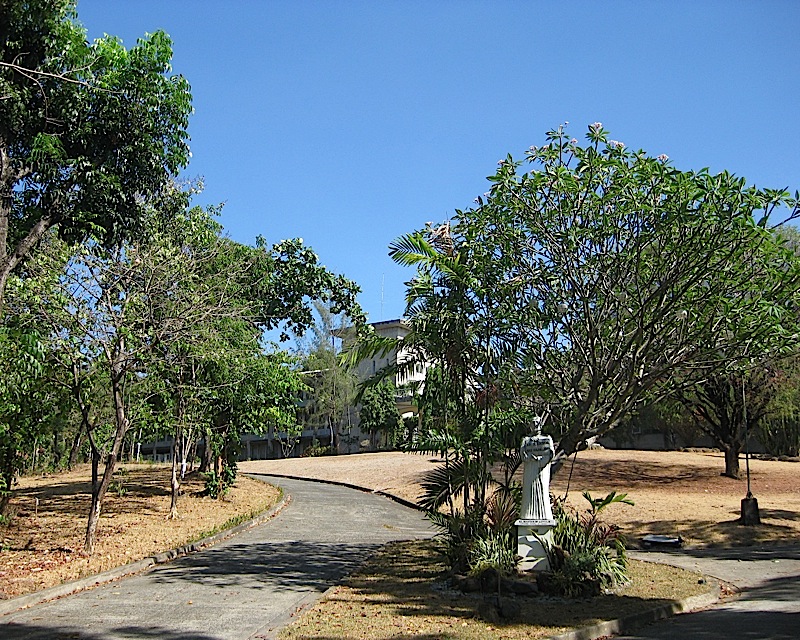
The two-day prayer recollection that I went to earlier this week was held at the Loyola Retreat House in the town of Angono in Rizal Province, east of Metro Manila. It is run by the Society of Jesus and visitors and retreatants are greeted by a statue of St. Ignatius of Loyola holding his Spiritual Exercises, which was the basis of our recollection, though in a much shorter form.

driveway of the Loyola Retreat House in Angono, Rizal


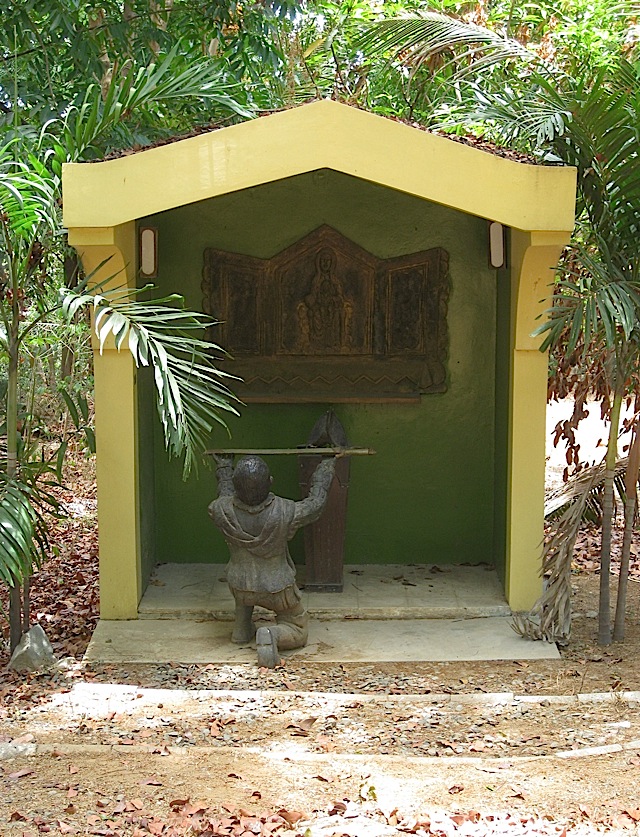
Almost hidden among the trees at the back of the retreat house is a small shrine depicting one of the most important events in the life of Ignatius. He was a Basque soldier and after his conversion, he made a pilgrimage to the Benedictine monastery of Santa Maria de Montserrat in Catalonia, Spain where he lay down his arms and armor in front of an image of the Virgin Mary.

a shrine at the Loyola Retreat House in Angono, Rizal


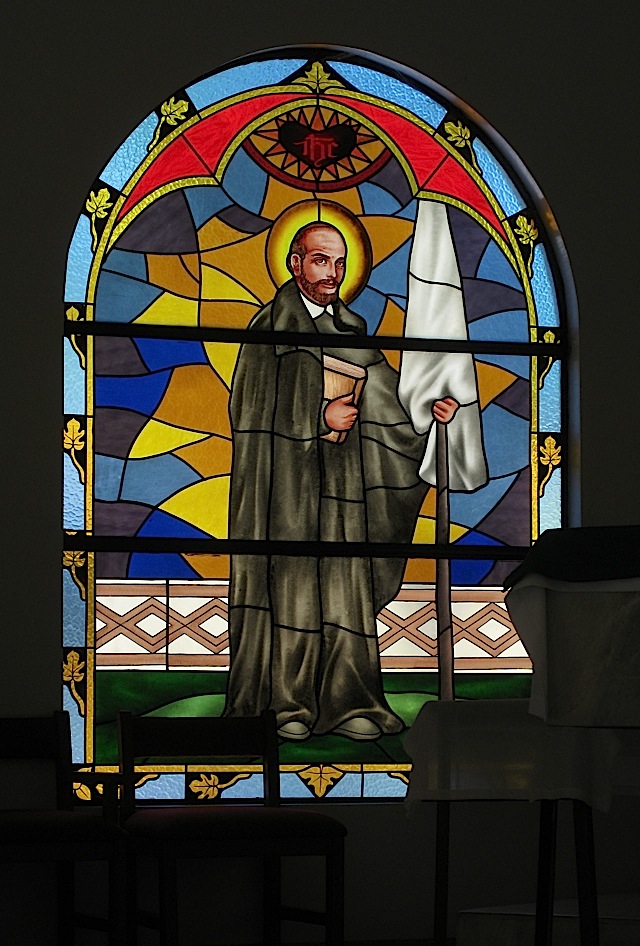
The Loyola Retreat House is nowhere near as gorgeous as last year's Caleruega. It is actually quite spartan in its furnishings and design, but since it is used strictly as a venue for spiritual retreats, I think it was a much better choice—it was completely quiet. The most extravagant adornments in the center are the beautiful stained glass windows in the small chapel. Again, St. Ignatius is depicted holding the book of the Spiritual Exercises in one of the four large windows behind the altar.

stained glass window depicting St. Ignatius of Loyola at the chapel of the Loyola Retreat House in Angono, Rizal


Urban or rural, natural or man-made, take a sightseeing tour of our world's diverse scenery!
Scenic Sunday