


Showing posts with label Intramuros. Show all posts
Showing posts with label Intramuros. Show all posts
Sunday, February 6, 2011
Eureka!
I had no success trying to find out the name of the artist who created the sculpture in yesterday's post, but in the course of my search, I finally discovered who created the alien-looking sculpture inside Fort Santiago in the old walled city of Intramuros which I posted back in October of 2009. It is the work of Filipino artist Eduardo Castrillo, who specializes in metal (mainly bronze and brass) sculptures, and is titled "Youth's Cry of Defiance."
Thursday, September 16, 2010
The governor's gate
This small doorway through the thick walls of Intramuros is called the Puerta Postigo del Gobernador because it was near the Spanish Governor-General's palace. This is the door that Philippine National Hero Jose Rizal walked through when he was brought by Spanish soldiers from his jail in Fort Santiago to Bagumbayan where he was executed by firing squad in 1896. The little room where the guards of this doorway stayed was also where the young Manuel L. Quezon, who much later became the President of the Philippine Commonwealth, was incarcerated after he surrendered to the Americans in 1902.

Friday, August 6, 2010
Secular relic
After Philippine National Hero Jose Rizal was executed by the Spanish colonial government in 1896, he was buried in the Paco Cemetery with no identification on his grave. One of his sisters went around the cemetery and, seeing freshly turned earth on one grave site, asked the caretaker to mark it with "RPJ," Rizal's initials in reverse. After the Philippines declared independence from Spain two years later, she retrieved her brother's remains, which are now enshrined at the Rizal Monument in Luneta, the place of Rizal's execution. One bone with a bullet wound was enshrined separately in a glass urn which is kept in a glass case at the Rizal Shrine in Fort Santiago, where Rizal was imprisoned before his execution.


See what's reflecting what at James' Weekend Reflections.
Saturday, July 10, 2010
In defense of the faith
Fort Santiago, named after St. James the Greater, the Patron Saint of Spain, was built in 1571, soon after the arrival of Spanish conquistador Miguel López de Legazpi. Renovations were done on the fort in 1773, which included the construction of the Reducto de San Francisco Javier (Redoubt of St. Francis Xavier) and a tunnel leading to it from the main fort. The redoubt added to the defense of the seashore and the mouth of the Pasig River. In the 1980s, the redoubt was restored and converted into a shrine for Our Lady of Guadalupe. A replica of her image was brought to the islands by Fray Andrés de Urdaneta, one of the first five Augustinians in the Legazpi expedition.

Wednesday, July 7, 2010
A place to sleep
Part of the oldest building in Fort Santiago, the brick ruins which stand beside the Rizal Shrine were originally the barracks of Spanish soldiers built in 1593. During the American period, they were used as the homes of army officers and their families. The building was destroyed during WWII and only a few sections of the walls with arched windows and doorways remain standing. They look kind of lovely among the lush, green plants.

Saturday, May 29, 2010
No less grand
The main facade of the Minor Basilica of the Immaculate Conception, better known as the Manila Cathedral, has three doorways. The central doorway, which is the biggest, has large wooden doors with bronze relief panels depicting the history of the church, over which is a grand arch inscribed with the dedication of the church. The two side doorways are slightly smaller though their arches are just as richly ornamented with elaborate reliefs.

Monday, May 24, 2010
Inappropriate
I have featured many of the beautiful buildings and ruins of the historic walled city of Intramuros, which used to be the city of Manila during the Spanish colonial period. Now let me show you the most glaringly out-of-place structure in the district. Called the Clamshell, it is a huge airconditioned tent used for commercial and tourism exhibitions and trade fairs. It stands on the corner of Santa Lucia and Anda streets, which used to be the location of the Ateneo de Manila University when it was still in Intramuros. To come upon this tacky structure, especially when it's screaming with promotional banners and streamers, after seeing the elegant Spanish architecture of the rest of Intramuros, is jarring, to say the least. I really hope that the Intramuros Administration and our Department of Tourism decide to take it down in the very near future.

Wednesday, April 14, 2010
The palace of the governor
The Palacio del Gobernador in Intramuros is a 1978 reconstruction of the 17th century Spanish Governor-General's residence and office. The original building collapsed in the devastating June 3, 1863 Manila earthquake and was abandoned when the Governor-General moved to Malacañang Palace. Currently, the Palacio del Gobernador houses some government offices and is the home of the Intramuros Administration.

Wednesday, March 17, 2010
Old guard
The security guards in the historic walled city of Intramuros are dressed in uniforms patterned after those worn by the Guardia Civil during the Spanish colonial era.

I have one question though: did they have rubber boots back then?
It's that time of the month for me to bug CDP bloggers again! Our theme for April 1 is Red and the May theme day poll is up—don't forget to vote!
I have one question though: did they have rubber boots back then?
It's that time of the month for me to bug CDP bloggers again! Our theme for April 1 is Red and the May theme day poll is up—don't forget to vote!
Friday, March 12, 2010
Historical tour
The tram-bus used for tours in the historic walled city of Intramuros recalls the days when the city had a tranvia system. During the Spanish era, the street railway cars were horse drawn and operated by the Madrid-based Compañía de los Tranvías de Filipinas. Then in 1905, during the American era, it was turned into an electric street tramway system operated by the Manila Electric Railroad and Light Company. This tram-bus was parked inside the Puerta de Santa Lucia (gate of Saint Lucy), one of the original entrances to the walled city. Built in 1603, the gate was destroyed during the Battle of Manila in 1945 and restored only in 1982. Reflected in the rear window is one of many new buildings in Intramuros built using Spanish architectural designs popular in Manila during the 18th and 19th centuries.


See what's reflecting what at James' Weekend Reflections.
Thursday, March 4, 2010
A glimpse of history
On the ramparts of the historic Fort Santiago in the old walled city of Intramuros, looking out towards the dome and clock and bell tower of the Manila Cathedral, at noontime during an overcast day.


Visit the Sky Watch Friday home page and tour the skies of our beautiful world.
Thursday, January 28, 2010
A Spaniard in a Roman plaza in Manila
In front of the Manila Cathedral is a small park with a fountain and a bronze statue. During the Spanish colonial period, the open space was called the Plaza Mayor and was the site of bull fights and other public events. In 1797, the Spanish Governor-General of the Philippines Rafael Maria de Aguilar y Ponce de Leon turned it into a garden. The bronze statue of Carlos IV, king of Spain from 1788 to 1808, was installed in 1824 as a tribute for his sending the first smallpox vaccine to the Philippines. During the American period, the park was named Plaza McKinley after William McKinley, who was then the president of the United States. Since 1960, it has been called Plaza Roma because of a reciprocal agreement between the Philippine government and the Vatican (there's supposed to be a Piazza Manila somewhere in Rome).

The Intramuros Administration says that they refurbished the park in 1980. I think it's about time that they reconditioned the bronze statue again.

The Intramuros Administration says that they refurbished the park in 1980. I think it's about time that they reconditioned the bronze statue again.
Saturday, January 9, 2010
Camouflage
I know I've posted so many photos of the Manila Cathedral already, but it has such beautiful details I don't think I'll ever tire of it (and I hope you won't either). I especially like how the carvings are ornate but almost nothing is painted, so the interior looks deceptively simple from afar. The interior arches are just as lovely as those over its main doorway, though the designs are geometric rather than floral. I guess speakers are necessary in a church of this size else the congregation won't be able to hear the priest, but at least the church authorities had the wisdom to choose a color which blends with the stone.

Monday, January 4, 2010
Corridor café
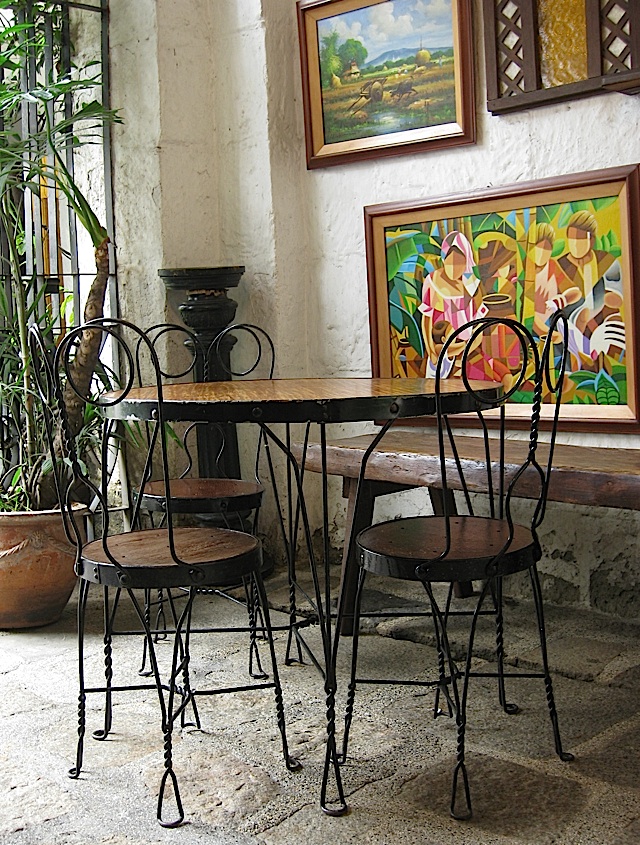
Barbara's Café in the old walled city of Intramuros is located in one of the wide passageways that lead from the street to the inner courtyard of the Plaza San Luis complex. Called a zaguan, it was the corridor where carruajes (horse-drawn carriages) would pass through to drop their passengers off by the entrance. The floor is paved with granite, what was and still is called piedra china (Chinese stone) because they were originally used by Chinese traders as ballast in their junks. The chairs and tables at Barbara's Café are what we call batibot chairs and tables. Batibot means 'small but strong and sturdy.' The wooden seats and tabletop are wrapped in sheet iron, and the legs and seat backs are made of bent iron rods; even the studs and rivets are made of solid iron.
Monday, December 7, 2009
Cherubim on high
December 8 is the feast day of the Immaculate Conception, the patroness of the Archdiocese of Manila. To commemorate this Roman Catholic holy day (which, beginning this year, is no longer a holiday in the Philippines), I offer you another view of the Manila Cathedral, which is also known as the Minor Basilica of the Immaculate Conception. The symbol on the round plaque underneath the cross is the coat of arms of the Holy See which features the papal tiara and Saint Peter's crossed keys.

ADDENDUM: Because so many are asking. This feast day used to be a holiday for Catholic institutions all over the Philippines. But on May 20, the Catholic Bishops' Conference of the Philippines (CBCP)—think of it as the government of the Catholic Church in the country—declared that it will no longer be so. It is still a holy day, however, and Catholic schools are asked to organize activities related to the solemnity (Mass, Rosary, forums and programs on Mary) "to capture the true spirit of the holy day and make its celebration more meaningful."
ADDENDUM: Because so many are asking. This feast day used to be a holiday for Catholic institutions all over the Philippines. But on May 20, the Catholic Bishops' Conference of the Philippines (CBCP)—think of it as the government of the Catholic Church in the country—declared that it will no longer be so. It is still a holy day, however, and Catholic schools are asked to organize activities related to the solemnity (Mass, Rosary, forums and programs on Mary) "to capture the true spirit of the holy day and make its celebration more meaningful."
Friday, December 4, 2009
Coastal defense
The historic Fort Santiago built by the Spaniards in the late 16th century continued to be used as such all the way to the 1940s, when it was the headquarters of the Philippine Division of the U.S. Army. Old canons can still be found scattered throughout the fort today, though I don't know if they are relics from the Spanish or American era. This one is trained on Manila Bay, which used to be much nearer the walls before land was reclaimed from the sea. Trees, weeds and moss now surround and grow on the old fortification. I like that.

Friday, November 20, 2009
The castle and the lion
The abbreviated Spanish coat of arms above the main entrance of Fort Santiago, built in the late 16th century soon after the conquest of the islands. The major elements are the Pillars of Hercules, the Spanish royal crown, the lion rampant of the Kingdom of León and the tower of the Kingdom of Castile. Philip II was the king of Spain at the time, which is why the islands were called Las Islas Filipinas.

Saturday, November 14, 2009
Vermilion tears
Walking along the mossy ramparts of the historic Fort Santiago in Intramuros, I spied a statue of Philippine National Hero Jose Rizal through the branches of a flowering Caballero/Flame Tree (Delonix regia) in a gated and locked room inside the roofless ruins of a former Spanish military barracks. Rizal was incarcerated at Fort Santiago before his execution in Bagumbayan (Luneta or Rizal Park) in 1896.


Urban or rural, natural or man-made, take a sightseeing tour of our world's diverse scenery!
Monday, November 2, 2009
A new old door
Our East Gwillimbury tour guide asked in my CDP theme day post why the Manila Cathedral had been built so many times since the 16th century. The answer is simple: fires, when Manila's structures were made mostly of wood and bamboo, and earthquakes, when stone was finally used. Then of course, there was the Battle of Manila during WWII when almost the entire city was razed to the ground. The war especially is the reason why, despite the age of the city, we have very few old buildings and those that look old are usually just reconstructions. However, even in the old walled city of Intramuros, only buildings with historical significance were reconstructed. Intramuros used to be the City of Manila but is now just one of its districts. It is a commercial zone and therefore has many office buildings. It has a law which I love though: any new structure built there has to follow the architecture of the Spanish colonial era. This office building is probably very modern inside but it doesn't look out of place beside the Manila Cathedral or the San Agustin Church.

Sunday, November 1, 2009
An older door
The San Agustin Church in Intramuros, unlike the Manila Cathedral, was able to survive WWII. In fact, it is the oldest known church still standing in the Philippines. It was completed in 1607 and the magnificent carved doors, slowly and carefully being stripped of the grime of the centuries, bear the pierced heart of Jesus and bible symbol of the Order of St. Augustine. Through the door, you can see a portion of the arched vestibule. Looks like relief, doesn't it? But it isn't. The entire interior walls and ceiling of the San Agustin Church is covered with amazingly realistic trompe l'oeil ornamentation.

Subscribe to:
Posts (Atom)
